Disclosure: This post may contain affiliate links. If you buy through these links, we may earn a commission at no extra cost to you.
It is a familiar weekend routine. You wash the sheets, fold them while they are fresh, and neatly stack them in the linen closet. In that moment, the small space looks perfectly organized. It smells like clean laundry and good intentions.
But a small, heavily used closet rarely stays that way. A few days pass, and the reality of a tight space sets in. You pull one pillowcase from a tight stack, and the whole shelf shifts. A sweater you wore for one errand ends up tossed on top of the clean linens. Eventually, you pull out a spare sheet set, and instead of smelling fresh, it smells exactly like the back of a closet: closed-in, dusty, and slightly stale.
A scented sachet might make the space smell nicer for a passing moment when you open the door, but it does not fix the underlying storage problem. This is a reset for the small-space closet that is tired, crowded, and making your clean laundry smell old.
Quick answer
The short version
If your clean sheets smell stale after a few days in a small closet, the problem is usually trapped moisture, pressure, and lack of airflow, not your laundry detergent.
- Cool first: Let sheets reach room temperature before folding them into a closed closet, especially if they came from a hot dryer.
- Lower the stacks: Switch from tall towers to short lanes so towels and sheets are not crushing one another.
- Separate half-worn clothes: Give once-worn sweaters or jeans their own hook or rail so they stop landing on clean bedding.
Why Clean Sheets Smell Stale in a Tiny Closet
When bedding develops a stale or cardboard-like scent shortly after washing, it is rarely only about how it was cleaned. It is usually a mechanical problem with how it is stored.
Textiles need room to breathe. Cotton, linen, and synthetic blends all sit in the air around them. When a closet is tiny and packed full, there is very little air left to circulate. Heavy bath towels press directly against lighter sheets, forcing out whatever space was between the folds.
Closets are also dark, closed spaces. If residual warmth from the dryer or surrounding bathroom humidity gets trapped between tight layers of fabric, it has nowhere useful to go. It settles into the folds and helps create that stale, closed-in odor. Before you buy another room spray or re-wash the entire linen stack, address the physical environment of the closet.
The Boring Reset: Empty, Wipe, and Air
You cannot organize your way out of a dusty shelf. The first step is the least exciting but the most necessary: take everything out.
Empty the closet, or at least the worst shelf. Once the shelves are bare, inspect the corners. If the stale smell keeps returning after drying, spacing, and cleaning, check the closet itself for dust, dampness, or dark moisture marks. Sometimes the stale scent is coming from the shelf surface, an old corner, or a damp spot that went unnoticed in the dark.
Wipe down the shelves with a damp cloth and a mild cleaner that is safe for the surface. If you are starting fresh in a new place, the same calm approach from a first apartment cleaning starter kit applies here: keep it simple and let surfaces dry fully before putting fabric back. Putting linens onto a damp shelf immediately undoes the reset.
While the closet airs out, sort your linens. Be honest about what belongs in this specific, small closet. If heavy winter duvets or holiday tablecloths are taking over the primary everyday shelf, they are robbing your daily sheets of the space and airflow they need. Move long-term storage items out of the high-traffic zones.
Rebuild Shelves as Lanes, Not Towers
The default method for storing sheets is to stack them as high as the shelf allows. In a small closet, that is a failure waiting to happen.
When you build a tall tower of sheets, the top items press down on the bottom items, trapping stale air and making retrieval harder. When you try to pull a single flat sheet or extra pillowcase from the middle of the pile, friction drags the rest of the stack with it. The tower leans, crumples, and eventually collapses.
Instead of towers, build lanes.
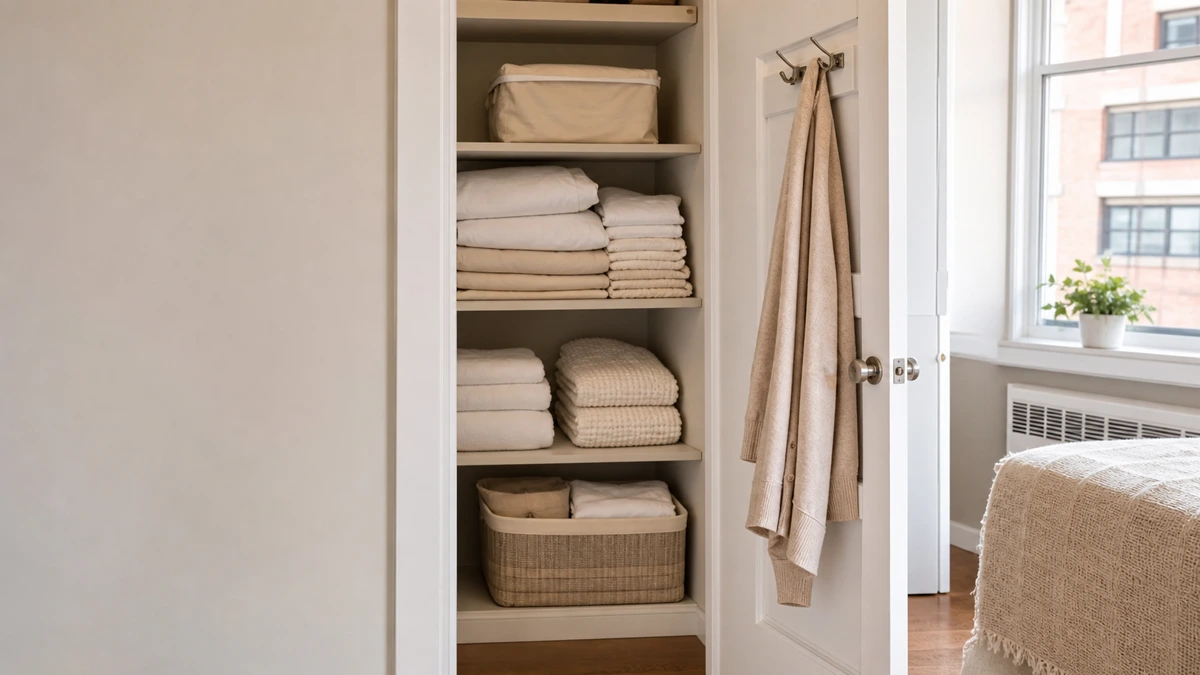
Divide the shelf horizontally rather than vertically. Keep stacks short, usually no more than two or three items high. A shelf divider or simple shelf riser can help maintain those lanes if it fits the actual shelf. Dividers act as retaining walls, keeping heavy bath towels from pressing sideways into lighter sheet sets.
| Storage method | The reality in a small closet | The result |
|---|---|---|
| Tall towers | Stacks lean and collapse when one item is pulled; heavy pieces crush the bottom linens. | Frustration, compressed folds, and trapped stale air. |
| Deep bins | Opaque containers hide extra pillowcases and guest towels until they are forgotten. | Wasted space, rummaging, and items that can pick up a plastic or closed-in smell. |
| Short lanes | Items are stacked two or three high and separated by physical dividers or shelf zones. | Easier retrieval, visible inventory, and better airflow. |
Give Sheets Room to Finish Drying
One of the most common mistakes happens at the end of laundry day: moving sheets directly from a hot dryer into a dark, closed closet.
Clean sheets often go into storage while still warm or slightly humid. Even if they feel dry to the touch, the center of folded cotton can hold onto a little warmth. When you fold the sheets tightly, stack them, and shut the closet door, that trapped warmth can settle into the fabric instead of escaping.
Let sheets cool and breathe before they go into their permanent spot. Leave them unfolded on a bed for a while, or fold them loosely and let them sit on an open surface until they reach room temperature.
If you prefer to keep spare bedding covered, use a breathable fabric storage bag. Canvas or cotton-blend bags protect against dust while still allowing a little air movement. Avoid airtight plastic storage for linens that are still warm, slightly damp, or used often. Plastic can trap closed-in odors quickly, especially when the fabric was not fully dry.
Create One Place for Half-Worn Clothes
The linen closet often becomes the dumping ground for clothes in purgatory: not dirty enough for the hamper, but not clean enough to go back in the wardrobe.
It starts innocently. A sweater worn for one errand, a pair of jeans worn for a few hours, or a comfortable hoodie lands on top of the clean linens. Suddenly, freshly washed sheets are sharing airspace with something that smells like a coffee shop, city transit, or a brisk walk.
You need one clear place for half-worn clothes so they do not touch clean sheets. An over-door hook, slim rail, or single dedicated hook can provide a drop zone. It gets worn clothing out of the bedroom pile while keeping it separate from clean laundry.
Move Tiny Items Up or Forward
Small, slippery items are the enemy of an organized shelf. Silk pillowcases, spare washcloths, and random microfiber towels rarely stay folded. They slide off stacks, get pushed to the back, and end up in a crumpled, dusty heap.
You may have tried putting them in a bin. But deep opaque bins can hide extra pillowcases or guest towels entirely. You forget what you have, and when you need a washcloth, you end up digging through a dark box and wrinkling everything inside.
Instead, move tiny items up or forward. Use a clip hanger or cascading hanger for small accessories if you have a bit of hanging space. If you only have shelves, use an open-front basket or shallow label bin. An open-front design lets you see the inventory at a glance and pull one small item without moving the whole container.
Before you buy
Check this first
- Measure shelf depth, shelf height, and door clearance before buying dividers, risers, or bins.
- Check closet-door thickness and look for felt or rubber scratch pads before buying over-door hooks.
- Avoid airtight storage for linens that are still warm, slightly damp, or used often.
- Do not use fragrance products to mask moisture, mildew, dirty shelves, or overstuffing.
- If an organizer depends on an exact shelf or door measurement, wait until you can measure the actual closet.
Use Scent Only After the Storage Problem Is Fixed
It is tempting to buy a heavily scented product the moment you notice a stale smell. But adding fragrance to a damp, crowded closet does not fix the problem; it usually creates a new, confusing smell of lavender mixed with old dust.
Do not use fragrance products to mask moisture, mildew, dirty shelves, or overstuffing.
Once you have cleared the space, established lanes, and made sure linens are fully dry before storage, you can introduce a mild freshener if you like. A charcoal bag can help with light ambient odors. A cedar sachet can add a faint clean scent if no one in the home is sensitive to it. Keep it subtle. Sheets should smell like nothing, or faintly like clean cotton, not like a concentrated perfume aisle.
Start Small, Then Upgrade Where the Closet Fails
It is easy to look at a frustrating closet and assume you need an entire matching system of acrylic bins, woven baskets, and velvet hangers. Restrain that impulse.
Start small. Do the empty-and-clean reset. Fold items differently. Let sheets dry fully. Live with the new layout for two weeks. Notice where the friction points remain. If towels keep falling into sheets, buy one set of shelf dividers. If half-worn clothes still end up on the shelf, buy the over-door hook. Upgrade only where the closet still fails you.
What Not to Buy First
When attempting a closet reset, certain products often create more problems than they solve in a tiny space.
Avoid vacuum bags for everyday sheets. They can be useful for long-term storage of bulky winter bedding or guest duvets you rarely touch, but they are not ideal for sheets you cycle through every few weeks. Sealing, vacuuming, and unsealing is too tedious to maintain, and repeated compression makes everyday linens harder to use.
Skip bulky, rigid bins that take up more space than the items they hold. In a tiny closet, every inch matters. A thick woven basket might look beautiful, but if it eats up two inches of shelf space on every side, it may be working against you.
Do not buy heavy room sprays or automatic fragrance dispensers for a closed linen closet. Concentrated mist can settle onto the top layer of fabric and leave scent or residue where you do not want it.
FAQ
Why do clean sheets smell stale in a closet?
Clean sheets can smell stale when they are stored with poor airflow, especially if they retain trace warmth or moisture from the dryer. In a tightly packed closet, heavy items press air out of the fabric and any residual dampness has fewer chances to escape.
Should I use scented sachets or charcoal bags?
Use them only after you have fixed the storage problem. Charcoal bags can help with light ambient odors without adding fragrance. Scented sachets can be pleasant, but they should not be used to cover a stale or mildew smell.
Are vacuum bags good for sheets?
Vacuum bags can make sense for rare-use seasonal bedding, but they are not practical for everyday sheets. Repeated compression is a hassle, creates wrinkles, and prevents the fabric from airing naturally between uses. If you are trying to compress small travel items instead, our guide to small suitcase packing organizers explains when compression actually helps.
How many sheet sets should I keep in a small closet?
For a very restricted closet, two sets per bed is often enough: one on the mattress and one in the closet. If you prefer a buffer, a third set can work, but four or more sets for one bed usually crowds the shelf quickly.
What should I do with clothes I wore once but do not want to wash yet?
Keep them off clean linens. Use an over-door hook, slim rail, or dedicated bedroom-door hook if the closet door will not work. The goal is to create a strict boundary between completely clean storage and clothes that are still in rotation.
A Quiet Final Take
A functional closet does not require complex decanting or expensive matching systems. It mostly requires a basic respect for physics. Fabric needs room to breathe, dampness needs a place to escape, and a shelf can only hold so much weight before it becomes a burden.
By cooling your laundry, lowering your stacks, and protecting clean linens from half-worn clothes, you remove the daily friction. The goal is not a closet that looks perfect for a photograph on laundry day, but one that actually hands you a fresh, clean pillowcase on a tired Wednesday night.