Disclosure: This post may contain affiliate links. If you buy through these links, we may earn a commission at no extra cost to you.
If your shower glass still looks streaky after cleaning, the issue is often hard water minerals, leftover cleaner, or the order you wipe and dry—not just a dirty door. This guide explains why shower glass gets streaky and how to fix the setup before you reach for stronger cleaners.
Related practical guides: hard water stains on faucets, bathroom drain smell and shower grime tools, no-drill small bathroom storage.
The first instinct is to blame the cleaner. Maybe the current spray is too weak. Maybe you need something stronger, more acidic, more serious.
Maybe. But with shower glass, the problem is often not the bottle under the sink. It is the fact that water is allowed to sit on the glass after every shower, carrying soap film and minerals with it until it dries into streaks.
Before you buy a stronger shower glass cleaner, set up a smaller routine that removes the water first.
Quick answer
The short version
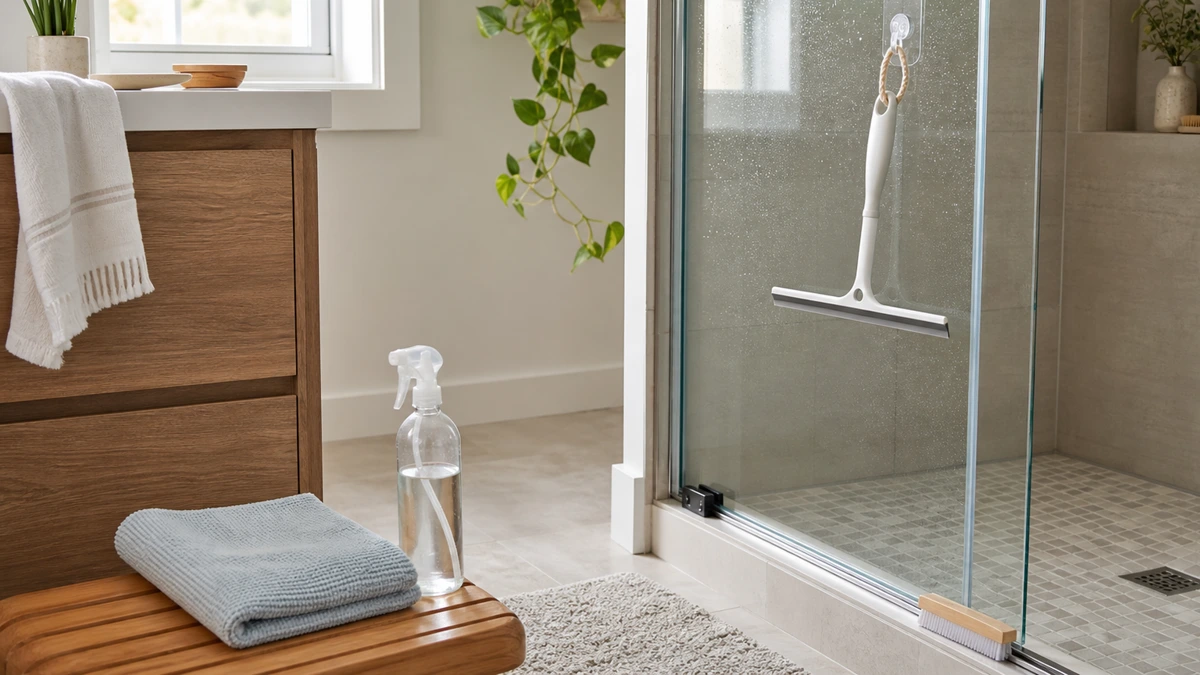
<p>If shower glass still looks streaky after cleaning, start with water removal, not a harsher cleaner. A compact squeegee, a flat-weave microfiber cloth, and a visible no-drill hook can do more for daily streaks than another bottle of spray.</p>
- Best first fix: squeegee the glass right after showering while water is still sitting on the surface.
- Finish the edges: use a lint-free glass cloth for corners, the lower edge, and leftover blade lines.
- Skip first: stronger acids, abrasive pads, or random cleaning hacks before checking the glass, frame, coating, tile, and cleaner label.
The goal is not to turn shower cleaning into a second job. It is to make the useful step so easy that you actually do it.
Why Spray Alone Keeps Letting You Down
Most people treat shower glass like a mirror. It looks dirty, so you spray it, wipe it, and walk away.
Shower glass has a harder job. It gets warm water, shampoo, body wash, skin oils, and whatever minerals are in your water supply. If those dry on the door every day, a basic glass spray may only smear the film around. You wipe, it looks fine for a few minutes, and then the streaks reappear as the last moisture evaporates.
Stronger cleaners can help with some deposits, but they also add risk. In a small bathroom, heavy fumes feel worse. Around a shower, chemicals may touch metal finishes, seals, caulk, grout, tile, stone, or factory coatings on the glass. Not every surface wants the same treatment.
That is why the first move should be mechanical: get the water off the glass before it dries there.
Step 1: Put a Squeegee Where Your Hand Already Is
A squeegee is not exciting, but it solves the problem at the right moment. While the water is still sitting on the glass, you pull it down toward the drain instead of letting it turn into a mineral-and-soap outline.
The mistake is buying any random squeegee and storing it under the sink. In a tiny bathroom, that routine dies fast. You are not going to finish showering, step out, open a cabinet, find the tool, and go back in.
Look for a compact shower squeegee that fits the actual door or screen. A huge window-style blade may look efficient, but it can hit handles, frames, or the edge of a narrow sliding panel. An 8- to 10-inch blade is often easier to control in a small stall.
Choose a flexible edge that glides without skipping. A comfortable, non-slippery grip matters more than a fancy metal handle. If the squeegee has a hook hole or loop, that is not a bonus detail; it is what keeps the habit alive. Replacement blades are worth checking too, because nicked or hardened blades leave lines behind.
If a heavy metal squeegee makes you nervous in a tub or tile shower, choose a lighter plastic or silicone-wrapped one. The best tool is the one you can use quickly without babying it.
Step 2: Use a Glass Cloth for the Last Ten Percent
A squeegee removes most of the water. It does not usually get everything.
The bottom edge still collects a thin line. The vertical frame may hold a few drops. If the blade skips once, you get a narrow wet trail. Those small leftovers dry into the marks that make the door look dirty again.
This is where a dedicated microfiber glass cloth helps. Not the fluffy towel you use for dusting, and not the old bath towel hanging nearby. A flat, tight-weave microfiber cloth labeled for glass, mirrors, or polishing is less likely to leave lint behind.
Fold it so you have a few dry sides. After the squeegee pass, use it lightly on the lower edge, the corners, and any visible blade lines. You do not need to polish the whole door every time.
Care matters here. Fabric softener can coat microfiber and make it push water around instead of absorbing it. Wash glass cloths without softener or dryer sheets, and keep a few in rotation so the one near the shower is actually dry when you need it.
Step 3: Make the Storage No-Drill and Obvious
The most underrated part of this setup is where the tools live.
A squeegee hidden under the sink is basically decoration. A microfiber cloth tossed on the tub ledge gets damp, falls, or starts looking like clutter. In a small bathroom, the tool has to be visible without being in the way.
For renters, a wet-area adhesive hook or a tiny shower caddy can work better than drilling into tile. Before you attach anything, check the surface. Adhesive hooks usually do better on smooth glass, glazed tile, or fiberglass than on textured tile, porous stone, or painted surfaces just outside the shower.
Check the wet-area rating, load limit, and removal instructions. Some adhesive products are meant for dry walls, not steamy showers. If the packaging tells you to clean the surface first and wait before adding weight, follow that timing. A hook that falls at 2 a.m. is a good way to stop liking the routine.
If adhesive feels risky, an over-the-glass hook or a small hanging caddy can be a cleaner compromise. The point is simple: the squeegee and cloth should live where your hand can reach them before you leave the shower.
Before you buy
Check this first
- Measure the glass panel width before choosing a squeegee blade.
- Check whether your shower has coated glass, natural stone, delicate metal finishes, soft caulk, or old seals before using stronger cleaners.
- Choose storage that works with your surface: smooth glass, glazed tile, fiberglass, stone, or painted wall all behave differently.
- Skip fluffy towels and paper towels if lint is part of the streak problem.
Step 4: Treat the Track and Lower Edge Separately
Sometimes the glass is mostly clean, but the shower still looks grimy. The problem is the frame, the sliding-door track, or the lower seal.
That bottom area collects water, hair, soap, and dust. A cloth wrapped around your finger rarely reaches the narrow grooves well, and paper towels shred before they do anything useful.
A shower-door track brush is a small, boring tool that earns its space. Look for a narrow head, firm-but-not-brutal bristles, and a shape that rinses clean easily. You are not trying to scrape the finish off the track. You are loosening the film in the place the squeegee cannot touch.
If the rubber sweep or plastic seal at the bottom is yellowing, brittle, split, or holding dark residue inside the material, cleaning may not fix it. Some parts eventually need replacement. That is a different problem from simple streaky glass.
Step 5: Use a Light Weekly Reset, Not Daily Scrubbing
Even with a daily squeegee habit, shower glass can build a thin soap film over time. You may notice the squeegee starts to chatter, or the glass feels slightly tacky instead of smooth.
That is the time for a light reset.
Use a non-scratch sponge or pad with a cleaner that matches your shower materials and the product label. Avoid heavy green scouring pads, abrasive powders, and aggressive pressure. Small scratches can make glass look permanently duller and give residue more places to cling.
A small refillable spray bottle can make this easier if you already have a compatible mild cleaner you like. Choose one with a fine mist instead of a hard stream, and label it clearly. If you refill from a larger bottle, a tiny funnel saves the annoying counter spill that makes you avoid the job next time.
This is not about keeping a chemistry kit in the shower. It is about making the occasional reset easy enough that you do not wait until the door looks hopeless.
| If you notice… | Try first | Be careful with… |
|---|---|---|
| Cloudy drip lines after every shower | Daily compact squeegee | Buying stronger cleaner before removing standing water |
| Lint or haze after wiping | Flat-weave microfiber glass cloth | Bath towels, paper towels, and fabric-softened microfiber |
| Dirty lower edge or sliding track | Narrow shower-door track brush | Hard scraping that may damage metal finishes |
| Squeegee skips or chatters | Light weekly reset and check the blade edge | Pressing harder, which can bend the blade and leave more lines |
| Stubborn chalky spots | Material-safe hard-water cleaner after checking labels | Acids near natural stone, delicate finishes, old seals, or coated glass |
When a Stronger Cleaner Might Actually Make Sense
After two weeks of water removal, you may still see stubborn cloudy patches. That is when a more targeted cleaner might be reasonable.
First, look at what kind of mark you have. If the spots are chalky, white, raised, and do not wipe away with a damp cloth, you may be dealing with mineral scale. A squeegee prevents more buildup, but it will not dissolve deposits that are already stuck there.
If the glass still looks cloudy even after careful cleaning, it may be etched. Long-term mineral exposure can damage the surface so the haze is no longer just sitting on top. No cleaner can promise to reverse that.
Also check the surrounding materials. Strong limescale products, acids, abrasive pastes, and magic-eraser-style pads are not automatically safe around natural stone, metal finishes, grout, seals, caulk, or coated shower glass. Read the cleaner label, check the shower-door guidance if you have it, and test in a small less-visible area before treating the whole door.
If the caulk is soft or peeling, the frame is rusting, the seal is degraded, or mold-like growth keeps coming back quickly, stop treating it like a streak problem. Cleaning the glass harder is not the fix for failing materials.
What Not to Buy First
Do not buy the strongest cleaner first. If the daily problem is water drying on the door, a stronger spray only helps after the streaks are already forming.
Do not buy a huge commercial squeegee for a narrow shower. It may cover more glass in theory and be annoying every single day in practice.
Do not buy fluffy microfiber towels and assume all microfiber behaves the same. Glass cloths are flatter, tighter, and less lint-prone.
Do not buy adhesive hooks without checking the surface and wet-area rating. A failed hook turns a simple routine into bathroom clutter.
And do not buy abrasive pads because you are frustrated. Scratched or stripped glass is much harder to live with than streaky glass.
Frequently Asked Questions
Do I really have to squeegee the glass after every shower?
For the clearest result, yes. The routine works because water does not get a chance to dry on the glass. If you share the bathroom, a realistic compromise is that the last person to shower does the quick squeegee pass.
Why does the glass look clean while wet but cloudy later?
Wet glass can temporarily hide film and deposits. As the water evaporates, it leaves behind minerals, soap residue, and body-oil film. That dry residue is what shows up as streaks from an angle.
Can I just use vinegar?
Vinegar is a mild acid, not a universal shower fix. It may help with some light mineral deposits, but it is not safe for every surrounding material. Natural stone, some finishes, grout, seals, and coated glass may need different care. Check the materials and labels before using acids.
Why does my squeegee leave lines?
The blade may be dirty, nicked, too stiff, or worn out. Wipe the blade edge before using it, use light pressure, and replace the blade or tool if it has hardened or developed small cuts.
What if my shower glass is textured or frosted?
A squeegee works best on smooth glass. If the inside surface is textured, a blade may skip over the raised pattern and leave water behind. In that case, a highly absorbent microfiber towel may work better than a squeegee.
A Quiet Final Take
Buying a new cleaner feels like action. It is a small purchase with a clear promise.
But streaky shower glass is often a moisture-management problem before it is a chemical problem. If you remove the water while it is still on the glass, dry the edges with the right cloth, and keep the tools exactly where the habit happens, you may find that the cleaner you already own is enough for the occasional reset.
Set up the tiny routine first. Then decide whether the stronger bottle is actually solving anything.