Disclosure: This post may contain affiliate links. If you buy through these links, we may earn a commission at no extra cost to you.
Before you buy a bookcase for a small apartment, measure more than the empty wall. Shelf depth, walkway clearance, outlets, baseboards, and anti-tip limits can decide whether a tall bookcase actually helps or just makes the room feel tighter.
Related practical guides: small closet storage reset, small kitchen storage racks, no-drill bathroom storage for renters.
You find a standard BILLY-style shelf online. You grab a measuring tape, check the width of the wall, confirm the shelf will fit, and hit order.
Then it arrives. You stand it up, load your stuff onto it, and step back. Technically, it fits. But the room feels narrower, the balcony path is tighter, and the open shelves have turned every cable, notebook, and random receipt into part of the decor.
Small-apartment storage often fails quietly because it solves the wrong measurement. Wall width is not enough.
Quick answer
The short version
If you are buying a tall bookcase for a tight room, measure the depth and walking path first, not just the wall width. Open shelves can make a small apartment look messier, and a tall unit may need manufacturer-recommended anti-tip anchoring that a rental wall may not allow.
- Best first move: tape the footprint on the floor and live with it for a day.
- Measure first: depth, walkway clearance, shelf gaps, floor protection, outlets, doors, and baseboards.
- Skip first: a tall, deep, open bookcase if you cannot anchor it safely or if it turns a room into a hallway.
Here is what to measure, anticipate, and check before you commit to a bulky storage unit in a small space.
1. Measure the Walking Path, Not Just the Wall
The biggest mistake is treating a bookcase like a flat sticker on the wall. It is a three-dimensional box that pushes into your living space.
A standard tall bookcase is often 11 to 15 inches deep. That might sound minor until you place it in a narrow room. Losing a foot of floor space can change the way you move between the sofa and coffee table, the bed and closet, or the desk and door.
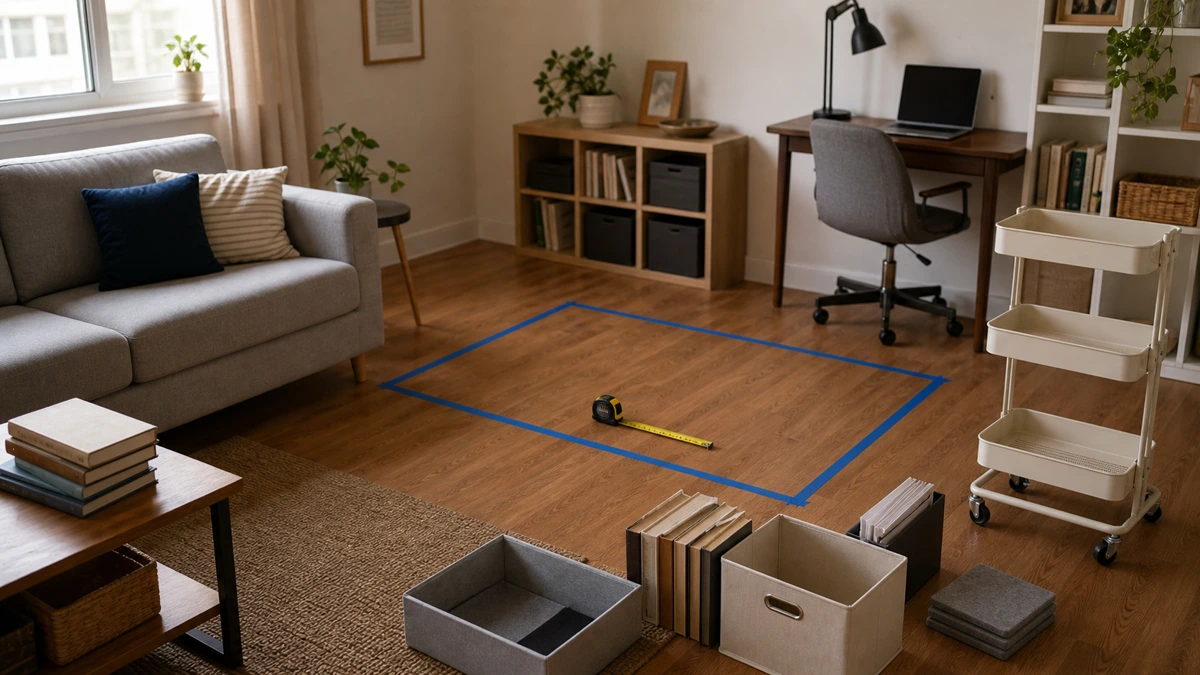
Before you buy anything, use a measuring tape and low-tack painter’s tape to outline the exact footprint on the floor. Test the tape first if your floor finish is delicate.
Now walk past it and check the hidden conflicts:
- Walking clearance: A primary path usually feels better with about 30 to 36 inches of clear space. Around 24 inches can work for a secondary shuffle path, but it will feel tight.
- Baseboards and molding: A shelf rarely sits perfectly flush. Thick baseboards can push an 11-inch shelf closer to 12 inches of real floor depth.
- Door swings, outlets, vents, and curtains: Open the nearby door or drawer, check the outlet, and make sure the shelf will not block airflow or crush fabric.
If the taped rectangle already feels invasive, the actual furniture will feel bigger.
2. Measure the Reality of Open Shelving
Product photos make open shelves look calm. Three color-coordinated hardcovers. One sculptural bowl. A trailing plant that somehow never drops a leaf.
Real shelves work harder. In a small apartment, a bookcase rarely holds only books. It collects a Wi-Fi router, chargers, mail, work notebooks, batteries, spare keys, candles, documents, and the things you put down “just for now.” When all of that sits on open shelving, you have not hidden the mess. You have framed it.
If you are buying the shelf for utility storage, plan for closed storage before you buy the furniture.
Cube bins and fabric drawers can make an open shelf feel calmer, but only if they actually fit. Measure the inside shelf height, width, and depth. Look for sturdy handles, a collapsible design if you move often, and a surface you can wipe or wash.
For a home-office corner, cable and document boxes can matter more than another shelf. Check ventilation, cord openings, lid access, shelf depth, and label space.
If the items you need to store are mostly unattractive household odds and ends, a huge open bookcase may highlight the problem. A lower unit with doors, fitted bins on the bottom shelves, or a few closed boxes on an existing shelf may do more for the room than a taller frame.
3. Measure the Gap Between Shelves
A bookcase can be large and still waste space.
Many shelves are spaced for tall hardcovers, art books, baskets, or display objects. If you mostly own paperbacks, notebooks, folders, or small electronics, you can end up with dead air above each row.
If you buy a big piece of furniture and still need extra piles beside it, the shelf did not solve the problem.
Shelf risers and stackable inserts can help use the upper half of a shelf gap. Check clearance, load limit, material, and non-slip feet. A riser that wobbles every time you grab a notebook will become clutter again.
Bookends and shelf dividers are just as practical. Choose enough height, a smooth edge finish, and enough weight or grip to keep books and folders upright.
This is the quiet test: if a smaller shelf plus risers, dividers, and two fitted bins solves the actual problem, you may not need the big unit at all.
4. Measure Your Lease Rules and Stability Limits
Tall furniture brings a safety issue that is easy to ignore while shopping: it can tip.
A tall bookcase loaded with books, boxes, or electronics has weight above the floor. If you bump it, pull a heavy box from a high shelf, or load it unevenly, the unit can become unstable. Many manufacturers include anti-tip hardware and tell you to secure tall furniture according to their instructions.
That is where renting gets awkward. Your lease may limit drilling, and your wall may be plaster, concrete, crumbly drywall, or another type you do not know how to anchor properly.
Do not assume a tall bookcase is safe because it is heavy, wide, or freestanding. Follow the manufacturer’s assembly and anti-tip guidance for the exact unit you buy. If you cannot anchor a tall unit safely, or if you are not allowed to make the required wall attachment, treat that as a buying constraint, not a small inconvenience.
A low, wide console, waist-high shelf, or lower bookcase is often the better small-apartment compromise. It keeps storage closer to the floor, leaves more visual breathing room above it, and may avoid the anchoring problem depending on the product instructions.
Before you buy
Check this first
- Outline the shelf depth on the floor with removable painter’s tape, then measure the remaining walkway.
- Check the manufacturer’s assembly and anti-tip instructions before assuming a rental wall can handle the unit.
- Measure the inside shelf openings before buying cube bins, document boxes, shelf risers, or bookends.
- Decide whether the problem is books, papers, cables, visual clutter, or floor clutter. Each one needs a different storage fix.
5. Measure the Floor Protection
A big bookcase becomes much heavier once it is loaded, and all that weight sits on a few legs, a narrow base frame, or a long bottom edge.
Small rentals often have vinyl plank, laminate, soft wood, or basic flooring that scratches more easily than you expect. Prepare the bottom before you load the furniture.
Felt pads and floor protectors are small, unglamorous purchases, but they are useful. Check the adhesive strength, thickness, and whether the pads are replaceable. If the furniture has a flat base instead of legs, felt strips may work better than small circles. If you need to move the unit during assembly, use furniture sliders before the shelf is loaded, not after it is already packed with books.
Floor protection will not fix a bad layout, but it can reduce one of the most annoying renter risks: buying storage to solve clutter and creating a floor scratch instead.
What to Buy Instead: Start Small
The urge to buy one massive storage unit usually comes from feeling overwhelmed. But once a huge piece is assembled, loaded, and wedged into a room, it is no longer a casual experiment.
Start with the smallest useful storage layer.
If you have a messy pile of books on a nightstand, you may only need sturdy bookends on an existing dresser. If your home-office papers are the problem, three document boxes and a narrow rolling cart may help more than a floor-to-ceiling shelf. If your living room needs general storage, a low, wide unit can hold bins and books while keeping the top surface available for a lamp, tray, or art.
A slim freestanding shelf can still be a good buy. Just make sure you are choosing it because the depth, shelf spacing, and stability fit your room, not because a tall shelf feels like the grown-up answer to clutter.
A narrow rolling cart can also help when you have no good wall for a bookcase, or when the items move between a desk, sofa, and dining table. Check wheel locks, width, handle height, and parked clearance.
| If the problem is… | Try first | Why it may work better than a big bookcase |
|---|---|---|
| Books or notebooks slumping on a dresser | Bookends or shelf dividers | Costs less, uses furniture you already have, and avoids adding depth to the room. |
| Open clutter that looks messy | Cube bins or document boxes | Hides the visual noise instead of putting it on display. |
| Small items wasting shelf height | Shelf risers or stackable inserts | Uses vertical space inside an existing shelf before you buy another unit. |
| No clear wall for a shelf | Narrow rolling cart | Moves where you need it and can tuck away when the path needs to stay open. |
| Rental wall cannot be drilled | Low, wide storage | Keeps weight lower and may avoid tall-furniture anchoring problems, depending on product instructions. |
What Not to Buy First
Do not buy the tallest shelf simply because it uses vertical space. Height only helps if the unit can be placed safely, anchored as required, and loaded without making the room feel top-heavy.
Do not buy an open bookcase for clutter you actually want to hide. If the shelf will hold cables, receipts, files, chargers, and everyday supplies, plan for bins and boxes from the start.
Do not buy a deep bookcase for shallow items. Paperbacks, notebooks, and small office supplies rarely need a 15-inch-deep shelf. A shallow shelf, media tower, or low console can save several inches of floor space.
And do not buy storage before sorting the pile. If half the items do not need to live in the room, a new bookcase will only give them a nicer place to sit.
Frequently Asked Questions
Do tall bookcases make a small room look smaller?
They often can, especially if the unit is deep, dark, heavily loaded, or placed where it interrupts a walking path. A tall shelf draws the eye up, which sounds helpful, but it also adds visual weight. In a small room, a low unit with closed storage may feel calmer than a tall open bookcase.
What is the best depth for a small-apartment bookcase?
It depends on what you store. Many standard bookcases are around 11 to 15 inches deep, but paperbacks and notebooks often need less. If you mainly store books, look for shallower options and measure your largest items before buying. If you need bins, measure the bins first and choose the shelf around them.
Is it safe to leave a tall bookcase unanchored if I do not have kids or pets?
Do not rely on that assumption. Follow the manufacturer’s assembly and anti-tip instructions for the exact unit. Tall furniture can become unstable from uneven loading, a hard bump, or pulling something heavy from a higher shelf. If you cannot anchor the unit safely or are not allowed to drill, consider lower storage instead.
How do I make an open bookcase look less messy?
Keep visual weight lower. Put heavier books, bins, and document boxes on the bottom shelves. Use bookends to keep rows upright, cable boxes for cords, and closed bins for miscellaneous items. Leave a little empty space where you can. A packed shelf often reads as clutter even when every item technically has a place.
A Quiet Final Check
The best storage furniture for a small apartment is the kind that gets out of your way. A giant bookcase might hold more things, but if you have to turn your shoulders every time you walk past it, you will notice that problem every day.
Tape the footprint on the floor. Walk around it. Open the door. Pull out the desk chair. Check the outlet, the baseboard, and the path you use when you are half-awake and carrying laundry.
If the tape feels like it is crowding you, the furniture will feel twice as big. Buy for the space you actually live through, not just the wall you want to cover.