Disclosure: This post may contain affiliate links. If you buy through these links, we may earn a commission at no extra cost to you.
Move-in day is a blur of heavy lifting, crowded stairwells, and packing tape. By the time the family car pulls away and you are alone in the room, the exhaustion catches up. You may be sitting on a bare mattress, sweating, surrounded by identical boxes and oversized plastic bins. The last thing you want to do is open all of them.
Yet you need your toothbrush. You need your phone charger. You need your contact lens case, your glasses, and something clean to sleep in.
This is the first-night trap. Students often arrive with an entire semester packed into heavy boxes, assuming the room will be unpacked in one afternoon. When that does not happen, finding one small necessity at midnight turns into a loud, messy dig through taped cardboard.
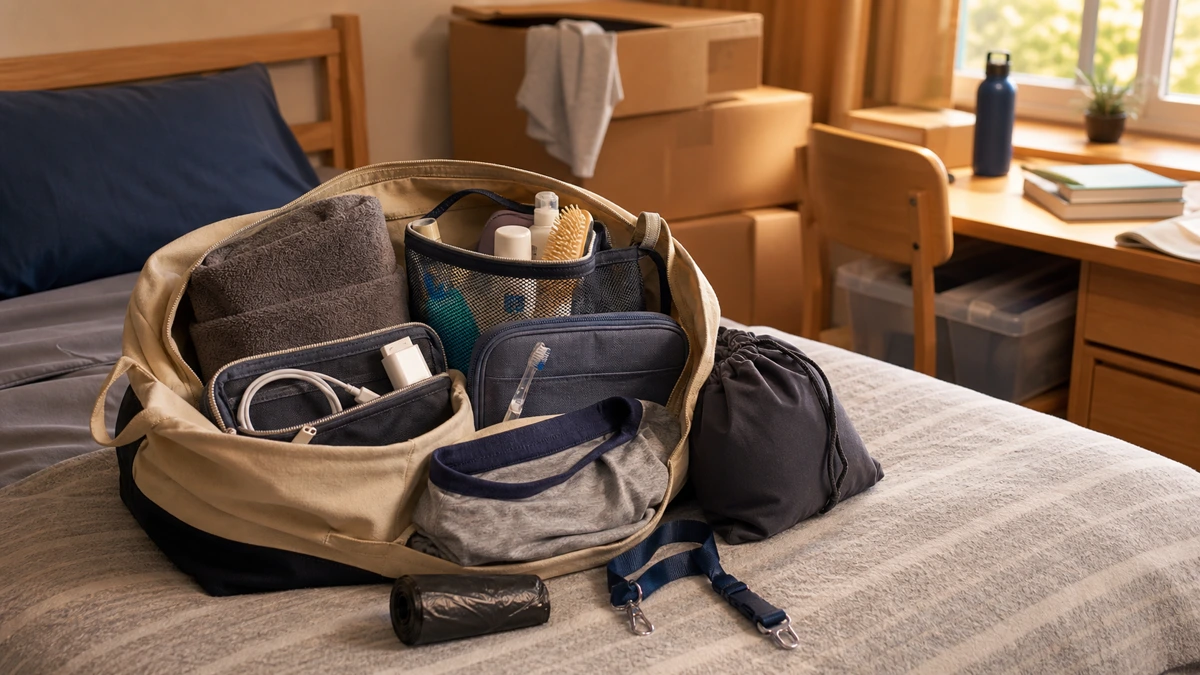
A dorm first-night kit solves that specific annoyance. It is one separate, easy-to-grab duffel or tote with exactly what you need for the first 24 hours on campus. Keep it in the front seat of the car or carry it over your shoulder, so when the dust settles, you still have a clear path to a shower, a charged phone, and a decent night of sleep.
Quick answer
The short version
Pack a small dorm first-night kit that stays separate from the moving boxes. It should cover the first shower, first sleep, first phone charge, and first morning before the room is unpacked.
- Keep within reach: Phone charger, toothbrush, glasses or contacts, clean sleepwear, shower tote, towel, shower sandals, and key/ID clip.
- Set boundaries fast: Add small trash bags and a foldable laundry bag so packaging, damp towels, and move-in clothes do not take over the bed or desk.
- Skip the full setup: The goal is not to organize the whole dorm on day one. It is to avoid digging through taped boxes at midnight.
The Bed Zone: Creating a Nightstand Out of Nothing
Dorm beds are sparse and awkward. You might have a lofted bed, a traditional bunk, or a basic metal frame pushed tight against a painted cinderblock wall. Rarely is there a perfectly placed nightstand waiting for you. Without a dedicated surface, your phone, glasses, earbuds, tissues, and allergy medication end up tangled in your sheets.
That is how glasses get bent, earbuds vanish, and a phone slips behind a heavy bed frame while you sleep. If you are on a top bunk, climbing down half awake just to stop an alarm is not something you want to do every morning.
Instead of fighting the mattress, plan for a bedside caddy or clip-on bed pocket. These fabric organizers slide under the mattress or strap to the bed frame, giving you a small drop zone for the things you need right before you fall asleep and the moment you wake up.
Check the attachment method before buying. A thick metal or custom wooden dorm bed rail might not fit a narrow plastic hook. Adjustable straps or a long fabric flap that slips deep under the mattress are usually safer for an unknown bed frame. Look for washable fabric, because these open pockets collect dust and lint quickly in a busy dorm room. You want a pocket deep enough that a taller phone will not tip out onto the floor.
If your roommate sleeps early, a lightweight low-heat reading light can help, but keep it optional. Avoid heavy plug-in lamps, exposed bulbs, or high-heat fixtures near the bed. Always check your housing rules before buying lighting, extension cords, or anything that plugs in near bedding.
The First Bathroom Trip: Managing the Hallway Shuffle
Taking a shower after move-in feels like a relief, but in a traditional dorm it requires a short commute. You have to walk down the hall carrying shampoo, body wash, a towel, shower sandals, student ID, and room key. Trying to juggle all of that in your arms is how a wet bottle of soap ends up on a dusty hallway floor.
A shower tote or mesh caddy is not just a neat organizer; it is what makes shared bathrooms manageable. Unlike private apartments where you might leave supplies in one place, as in a small bathroom storage setup, a dorm bathroom routine has to be mobile. Your supplies live in your room and travel only when needed.
Material matters. Hard plastic caddies can seem sturdy, but they may crack during travel and hold soapy water at the bottom if drainage is poor. Mesh dries faster and lets water pass through, which matters when the tote goes back into a small room.
Still, not every mesh tote is useful. Look for one with a reinforced standing base. A completely soft bag can collapse the moment you set it down, spilling bottles across the shower floor. Check the handle comfort too; you will carry it back and forth often. Thin or short straps get annoying quickly. The main compartment should be tall enough for your actual shampoo and conditioner, not just travel-size bottles.
Charging and Cables: Keeping the Lifeline Visible
Somewhere in a plastic tub of bedding, there is probably a tangle of cords. Charger blocks, earbud cables, laptop power cords, and watch chargers often get tossed into whatever box has extra space. When midnight arrives and you need to set an alarm for orientation, hunting for one wall adapter is miserable.
Keep a small cable pouch or cord wrap set in the first-night kit. The same idea behind small suitcase packing organizers applies here: contain the loose items before they disappear into a larger bag.
This pouch should hold only the immediate essentials: phone charger, wall block, earbud cable, and maybe a watch charger. Do not load it with heavy power strips, long extension cords, or unknown electronics. Dorm fire rules can be strict, and many housing departments restrict household extension cords. For the first night, stick to the basic charging cables you already use.
Make sure the pouch actually fits your wall charger block. Many slim tech pouches look good online but will not close over a bulky laptop brick. A soft-sided pouch in a bright color is ideal. It stands out against cardboard boxes, bedding, and neutral dorm furniture, which is exactly what you want at 11:30 p.m.
Laundry, Trash, and Keys: Setting Immediate Boundaries
A dorm room becomes messy the instant you open the first box. Sheet packaging, plastic tags, snack wrappers from the drive, and the clothes you wore while hauling boxes all need somewhere to go. If you do not set a boundary for trash and dirty laundry on the first night, the small floor plan gets messy fast.
For trash, skip the oversized kitchen can at first. Many universities already provide a small bin under the desk. Pack a roll of small trash bags or mini liners instead. Even if the room has no bin, you can use a small bag temporarily until you learn the building’s trash routine. It keeps sticky wrappers, tape, and packaging off the desk.
For laundry, use a foldable laundry bag or pop-up mesh hamper. It takes little space in the first-night kit but gives sweaty move-in clothes and damp towels a home that is not the floor or your clean bed. Look for ventilation and sturdy handles. Avoid sealing damp towels in plastic, because they can smell bad quickly in a warm room.
For keys and ID, create the habit immediately. Dorm doors often close and lock behind you. On the first night, when you are walking to the bathroom, water fountain, or hallway trash area, it is easy to leave your card on the desk. Use a lanyard, secure key clip, or bright landing tray. The key should be clipped to your bag, attached to you, or sitting in one obvious place. Avoid hooks that require drilling or permanent adhesive, since they can create room damage charges later.
Before you buy
Check this first
- Read your housing rules before ordering lights, extension cords, adhesive hooks, large bins, or anything that attaches to the bed.
- Measure bed height, rail thickness, desk space, closet width, and door clearance before buying larger organizers.
- Choose mobile items first: a shower tote, cable pouch, foldable laundry bag, and key/ID system are easier to use before the room layout is clear.
- Avoid buying bulky storage just because it appears on a dorm checklist. If it depends on the exact room, wait until you can see the room.
Start Small, Upgrade Later
A common expensive mistake is trying to furnish and organize the entire room before you have slept in it. You do not need every plastic drawer, cart, shelf, and organizer before move-in day. In a small shared room, buying too much storage early can create the clutter you were trying to avoid.
For the first night and first week, the basics are enough: a bed pocket, shower tote, cable pouch, foldable laundry bag, and key/ID system.
Once the boxes are flattened and you have lived in the room for a week or two, your real routine will show up. Maybe the closet is narrower than the floor plan suggested. Maybe the desk has less drawer space than expected. Maybe the laundry room is close enough that a simple mesh bag is fine.
At that point, measure the gaps and upgrade strategically. Let the room and your habits tell you what to buy, not a generic dorm checklist.
| Item | Start small | Upgrade later | Check before buying |
|---|---|---|---|
| Bedside storage | Simple fabric bed pocket | Reinforced caddy with deeper pockets | Bed rail thickness, attachment method, washable fabric |
| Shower tote | Basic mesh shower caddy | Structured quick-dry tote with reinforced base | Drainage, standing base, handle comfort, bottle height |
| Cable pouch | Small bright pouch for phone charger and earbuds | Padded tech pouch with dividers | Fits your charger block; avoid unverified power accessories |
| Laundry and trash | Foldable mesh hamper plus small trash bags | Handled laundry bag or compact hamper after you know the building | Ventilation, folded size, distance to laundry room |
| Key and ID habit | Lanyard or bright clip | Small tray or more permanent landing spot | No drilling, no permanent adhesive, easy to see when tired |
What Not to Buy First
In the rush to prepare for a new semester, it is easy to buy large items that seem helpful but get in the way during the first few days.
Avoid massive plastic tubs or heavy drawer sets right away. They take up valuable floor space while you are unpacking, and if they do not fit under the bed, they become permanent obstacles. Hold off on bulky rolling laundry carts too. If there is no elevator to the basement laundry room, a wheeled cart may be more trouble than it is worth.
Resist the decorative pillow haul. During the first week, the bed often becomes a staging area for folding clothes, sorting paperwork, and organizing books. Extra pillows usually end up on the floor.
Do not bring a commercial-size cleaning stash either. If you want a more complete setup later, use our first apartment cleaning starter kit as a calmer reference. For a dorm first night, a few disinfecting wipes and a small multi-surface spray are usually enough to wipe down the desk and mattress cover before you unpack clean sheets.
Frequently Asked Questions
Should I pack the first-night kit in a moving box?
No. The point is immediate access. Pack it in a distinct backpack, tote, or small duffel that rides with you, not in the back of a moving truck or under heavier boxes in the trunk.
Do I need a first-aid kit right away?
Yes, but keep it minimal. A few bandages, pain relievers, and a small tube of antibacterial ointment are enough for the first night. Move-in day involves lifting, walking, and opening cardboard, so minor blisters or cuts are common.
Can I pack an extension cord in my cable pouch?
Check your dorm’s fire rules before packing extra wiring. Many housing departments restrict standard extension cords and only allow certain surge protectors. For the first night, longer charging cables are usually a simpler choice.
How do I clean my mesh shower tote?
Rinse it after use and hang it somewhere with air circulation. If it starts to look grimy or smell damp, many soft mesh totes can go through a gentle cold wash, but air dry them instead of putting them in a hot dryer.
What if I share a room and my roommate arrives at a different time?
That is exactly when the first-night kit helps. If your roommate is already sleeping, you do not want to turn on every light and rip open noisy boxes. A single bag lets you quietly grab pajamas, toiletries, and your charger.
Quiet Final Take
Moving into a shared, unfamiliar space is stressful even when you planned carefully. You cannot control how heavy the boxes feel, how hot the stairwell is, or how long it takes to break down the cardboard. You can control the first night.
Keep your toothbrush, phone charger, clean sleepwear, and room key in one dedicated bag. Get through the first shower, charge your phone, sleep, and let the rest of the room wait until morning.