Disclosure: This post may contain affiliate links. If you buy through these links, we may earn a commission at no extra cost to you.
Before you buy an upholstery cleaner for your couch, check the fabric code, stain type, seams, cushion filling, and how much moisture the couch can safely handle. Some couches need a dry-first reset, while others may be damaged by the wrong cleaner or too much water.
Related practical guides: cleaning a rug without a yard or hose, first apartment cleaning starter kit, move-out cleaning walkthrough.
You shift your weight and hear the crunch of a rogue tortilla chip somewhere under the cushion.
This is usually when upholstery-cleaner videos start to look persuasive. The machine pulls dark water out of a cushion. It feels like a clear answer.
Then you look at your apartment: one small utility closet, a vacuum wedged next to the mop, and no extra shelf for another machine with a wet hose.
Before you buy one, pause. Most first-couch problems start with dry debris, unknown fabric care, and one small spot that got too much attention. The safer first move is boring but useful: check the code, clean dry, treat only what needs treating, and keep water out of the cushion foam.
Quick answer
The short version
Do not buy a bulky upholstery cleaner just because your couch looks stale. Find the fabric cleaning code, do a dry reset, then treat one small spot only if the tag allows water. Stop before the cushion gets wet inside.
- Best first fix: remove crumbs, hair, lint, and dust before adding moisture.
- Check first: look for W, S, WS, or X on the couch tag.
- Skip first: steam cleaning, soaking, heavy detergent, or a machine you have nowhere to store.
Find the cleaning code before you touch the fabric
Look under the seat cushions, along the bottom frame, or on the original paperwork. Most upholstered furniture uses a cleaning code. It is usually one letter or a short combination.
- W means water-based cleaning is usually allowed. Still spot-test first. “Water-safe” does not mean “soak the cushion.”
- S means solvent-based cleaning. Do not use water, steam, water-based foams, or a wet cloth.
- WS means the fabric may tolerate either water-based or solvent-based cleaning, but you should still start with the mildest hidden-area test.
- X means vacuum or brush only. No water, no solvent, no consumer upholstery machine.
If you cannot find the tag, treat the couch like it is sensitive. That is especially true for vintage, thrifted, leather, suede, velvet, silk-blend, antique, or unknown upholstery. A faint mark is annoying; a damaged panel is worse.
Do the dry reset first
A wet cleaner on a dusty couch makes mud. It also pushes grime deeper into the fabric.
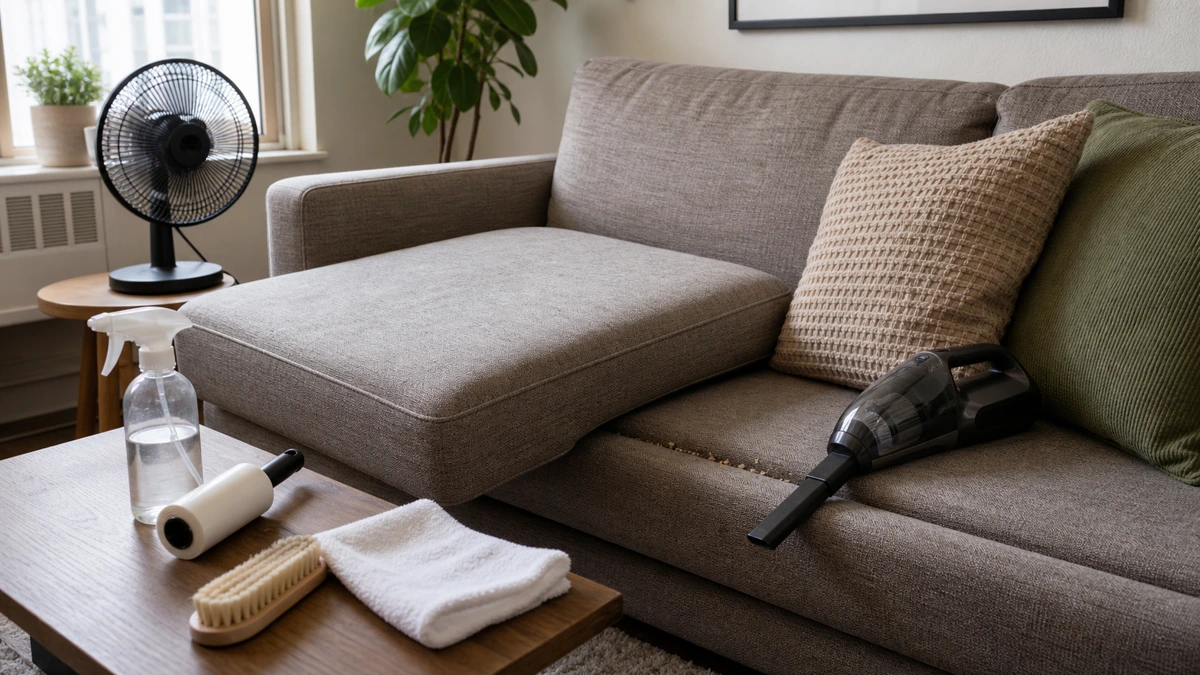
Remove loose cushions if you can. Use a narrow crevice tool or mini vacuum nozzle along the inner frame, the back ledge, the side gaps, and the line where the seat meets the back. Go slowly. This is where crumbs, hair, and grit sit for months.
For pet hair and lint, a lint roller or reusable pet-hair remover often does a better job than suction alone. Keep one near the couch if dark fabric shows every hair.
Then use a soft upholstery brush on armrests, headrests, and cushion fronts. Brush gently, then vacuum again. You are loosening dust, not scrubbing a pan.
A good dry reset can make the couch look cleaner before you use a single drop of water.
Treat one small spot, not the whole couch
If your couch is W or WS coded, you can handle a small spot without dragging in a machine. The goal is not to wash the couch. The goal is to lift the mark without driving moisture into the foam underneath.
Use white microfiber towels or white cotton blotting cloths. Colored rags can transfer dye when damp, and white cloths show what is coming off the couch.
Mist the spot lightly with plain water or a very diluted mild soap solution if the fabric code allows it and your hidden test looks fine. Do not pour from a cup. A fine mister helps you avoid flooding the area by accident.
Press the towel into the spot and lift. Blot again with a dry area of the cloth. If you use soap, follow with a light mist of plain water and blot again so residue does not stay behind and attract dirt.
If dye transfers to the towel, the texture changes, or the spot spreads, stop. More effort is not the same as better cleaning.
Make drying part of the job
Any time you add moisture, plan the drying route first. Open a window if the weather helps, turn on a ceiling fan, or aim a compact fan at the treated area. Prop loose cushions so air can move around them. Do not sit on the damp spot.
This is the part upholstery-cleaner videos skip. Extracting water is one thing. Getting the remaining moisture out of foam in a small room is another.
Before you buy
Check this before buying an upholstery cleaner
- Your fabric code: S and X couches are not good candidates for casual wet extraction.
- Your storage: the machine, hose, tank, and cleaner bottles need a real home.
- Your airflow: if your apartment dries laundry slowly, it may dry couch foam slowly too.
- Your actual problem: crumbs, pet hair, lint, and one small spot usually do not justify a bulky machine.
When a machine makes sense
Portable upholstery cleaners can be useful. The problem is buying one too early.
A machine may make sense if your couch has a W code, you deal with frequent spills, the whole surface is evenly soiled, and you have somewhere sensible to store the machine after it dries.
It makes less sense if you are fixing one coffee spot, your couch is S or X coded, or your apartment storage is already full. It also will not solve urine saturation, smoke odor, pest contamination, sewage contamination, moldy smell, or large unknown stains from a previous owner. Those are stop-DIY situations. Call a professional upholstery cleaner, check with a landlord if the couch came with the unit, or consider replacement.
If you are mostly worried about future mess, a washable throw or temporary sofa cover may be a better small-space buy. It is easier to wash a throw than to rescue a permanent cushion after every spill.
Small couch tools that earn their space
A useful couch kit should fit in a shoebox, not take over a closet.
Start with what works with your existing vacuum: a narrow crevice tool or mini nozzle for seams. Add a lint roller or reusable pet-hair remover if hair is a daily issue. Keep a soft upholstery brush for dusty armrests.
For spots, keep white microfiber cloths and a fine mister. If your fabric code allows light water-based cleaning, those two items give you control. A small fabric-safe sponge can help with a surface mark after a hidden-area test.
That is enough for most routine couch care. The point is to make small messes easy to handle before they become a weekend project.
| Couch situation | Try first | Avoid |
|---|---|---|
| Crumbs deep in seams | Crevice tool or mini vacuum nozzle | Pushing debris deeper with a wet cloth |
| Pet hair and lint | Lint roller or reusable pet-hair remover | Wet wiping, which makes hair cling |
| Dusty armrests | Soft upholstery brush, then vacuum | Scrubbing with water before removing dust |
| Small fresh spill on W/WS fabric | White cloth, light mist, gentle blotting | Rubbing hard or pouring cleaner directly on fabric |
| Stain on S or X fabric | Dry brushing, vacuuming, or professional advice | Water, steam, or water-based foam cleaner |
Mistakes that make a couch worse
Do not soak the foam. The visible fabric is only the cover. Under it is padding that can hold moisture long after the surface feels almost dry.
Do not use heavy detergent. Too much soap leaves residue, and residue grabs new dirt. That cleaned spot can become a darker patch a few weeks later.
Do not scrub in circles. It feels productive in the moment, but it can fuzz the fabric and leave a worn-looking mark that stays after the stain is gone.
Do not assume zippers mean machine washable. Many cushion covers have zippers because of manufacturing, not because the cover is meant to go through a washer. If the tag does not say machine washable, do not treat it like laundry.
Frequently asked questions
How often should I clean my couch?
Vacuum seams, remove pet hair, and brush dusty areas when they start to look dull. Wet spot cleaning should be occasional and targeted: only for a specific spill, and only when the fabric code allows it.
Can I use dish soap on a couch?
Only on W or WS fabric, and only in a tiny diluted amount after a hidden-area test. Use less than you think, then blot with a lightly damp plain-water cloth so soap residue does not stay in the fabric.
What if my couch smells but does not have a visible stain?
Start dry. Vacuum slowly, brush the fabric, and improve airflow. Some odor is dust, dander, and trapped debris. If the smell is smoke, urine, mildew, or something sour from inside the cushion, surface cleaning will not fix it.
Is steam cleaning a good first step?
No. Steam adds heat and moisture, which can damage sensitive fabric, set some stains, or change the texture of velvet and similar materials. Never steam an S or X couch. For a first couch in a small apartment, it is rarely the first move.
Should I buy a sofa cover instead?
Maybe. If the couch is basically clean but you are worried about everyday spills, a washable throw or temporary cover can be the smarter small-space choice.
Final take
A couch is meant to be lived on. It will catch crumbs. It will collect hair. It will look a little tired before anything is truly wrong.
Start with the least dramatic fix: read the tag, clean dry, treat one spot carefully, and respect the drying time. If that solves the problem, you saved money and closet space. If it does not, you can still rent, borrow, hire, or buy the bigger solution later with a better idea of what the couch actually needs.