Disclosure: This post may contain affiliate links. If you buy through these links, we may earn a commission at no extra cost to you.
It happens during every major online sale. You open a browser tab and the page is suddenly full of little promises: a tiered cart that looks made for the dead space beside your fridge, an over-the-door rack that seems to solve your bathroom, a drawer divider that appears to know exactly where the spatulas should go. The timer is red. The discount looks temporary. For a minute, it feels like you are not buying stuff; you are buying a more organized version of your apartment.
But major sale events are notoriously hostile to small apartments.
When your space has one awkward closet, a narrow bathroom, and a kitchen that makes you store baking sheets in the oven, the wrong "space-saving" item does not disappear politely into the background. It sits there. It blocks a cabinet. It gathers dust on top of the fridge. A cheap gadget becomes another cord behind the sofa.
Quick answer
The short version
The useful rule is simple: treat your apartment like a strict bouncer. If an item does not have a measured, designated home, it does not get in.
- Best first fix: A basic tape measure. You cannot organize a small rental by guessing scale.
- Measure first: Drawer depths, under-bed floor clearance, and door frames for over-the-door brackets.
- Skip first: Aspirational rolling carts, unbranded plug-in electronics, and bulk-pack acrylic bins for messes you haven’t actually measured.
Here is what to skip during a timed sale, what to check before you click buy, and how to defend your floor space against impulse purchases.
What Not to Buy First: The "Space-Saving" Illusions
The biggest trap of a major sale is the illusion of scale. Without a real room for context, everything looks reasonably sized online.
The Aspirational Rolling Cart
A slim rolling cart always seems brilliant in the photo. It is holding extra shampoo, stacked onions, or a perfect row of coffee pods. What the photo does not show is the wheel catching on your bath mat, the handle blocking a lower cabinet, or the cart becoming a mobile junk drawer you push aside every time you sweep. Before buying one, measure the full base width, including wheels and hardware. Unless you already have a mapped-out gap for small kitchen storage racks, the cart is probably asking for floor space you do not have.
The Bulk Organizer Trap
A 12-pack of clear bins looks sensible until the box arrives. Your pantry has two shallow shelves. You use four bins. The other eight go on top of the cabinets, where they collect that specific kitchen dust that is somehow both gray and greasy. Storage containers take up space too. If you buy more than your shelves can hold, you end up storing your storage. Buy the exact number you need, even if the smaller pack costs a little more per piece.
Cheap Electronics and Unknown Plug-Ins
Search results flood with deeply discounted, unbranded electronics: a $15 LED desk fan, a tiny plug-in heater, or a heated coaster. In a small apartment, outlets and counter space are scarce. High-load electronics from unknown brands are a safety risk, not a bargain. Skip cheap plug-in gadgets entirely. If you are solving a specific seasonal problem—like figuring out how to keep a room cool without AC—start with non-electric solutions like blackout curtains before plugging a dubious, noisy fan into an overloaded power strip.
The Pre-Cart Reality Check
If a storage solution looks helpful, run a dimensional reality check. Do not buy organizers based on vibes.
The Over-the-Door Miscalculation
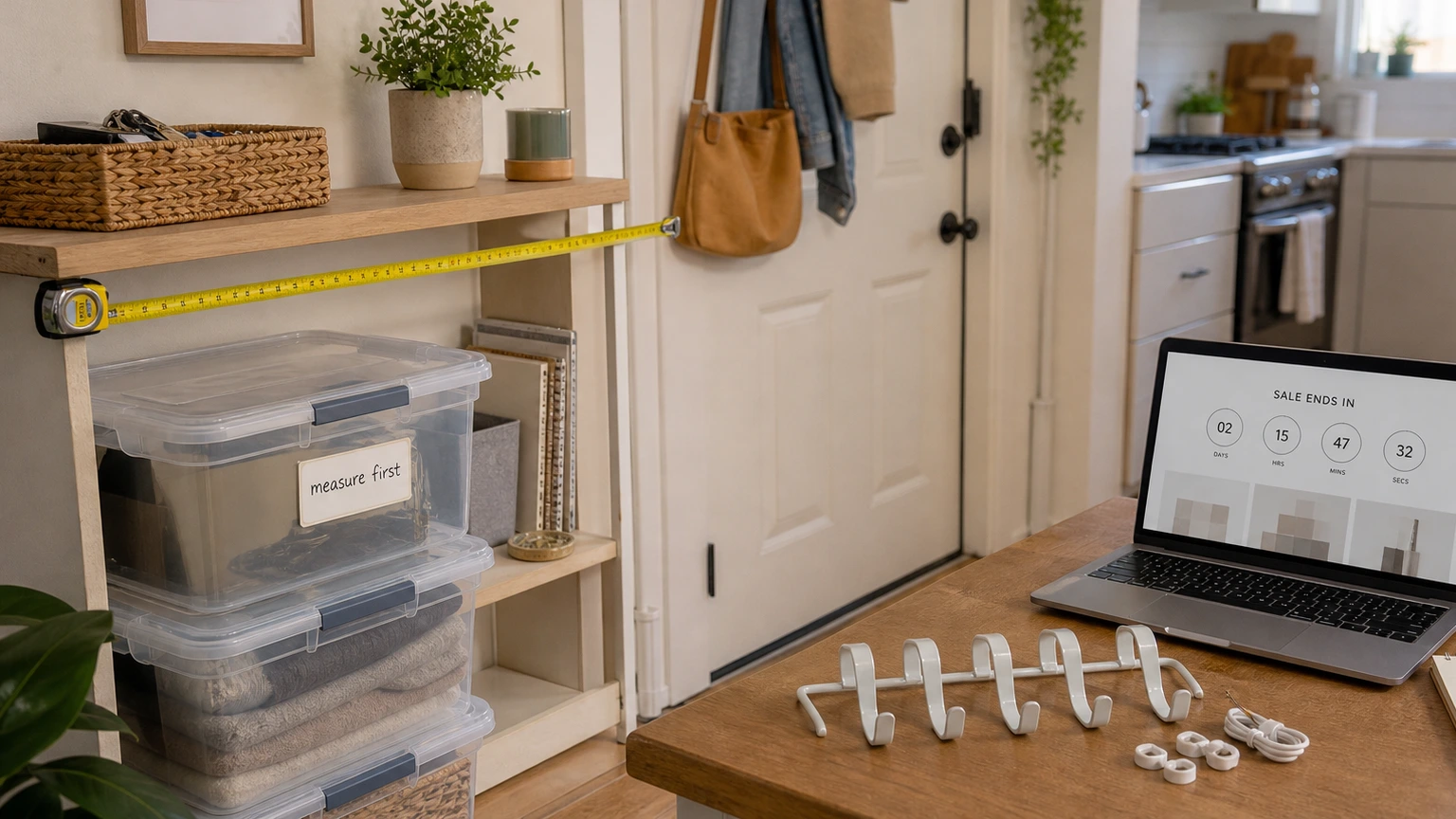
Over-the-door hooks are a classic apartment fallback. You buy a sturdy metal rack, hook it over the bathroom door, push it shut, and hear the scrape. The bracket is thicker than the gap between the door and the frame. Check this before you buy: place a quarter flat on top of your open door and try closing it. If the quarter jams or scrapes, a bracket will not fit. Also check hook depth. If the hooks stick out three inches, will they hit the wall when the door opens? Look for padded backings, and check rental rules before attempting permanent mounting.
The Under-Bed Reality
An under-bed bag seems perfect for winter coats, but the friction is structural. A soft-sided fabric bag looks neat in photos, but if your frame only has six inches of clearance, a bag stuffed with heavy wool will bulge to eight inches and get stuck. When you yank the fabric handle, the stitching tears. For under-bed storage, rigid sides are more reliable because they maintain their height. Measure exact clearance from the floor to the lowest hardware on your frame, not just the side rail.
The Unmeasured Drawer Divider
Expandable dividers seem universally helpful for messy desks, but drawers are notoriously non-standard. A 14-to-18-inch expanding divider is useless in a 12-inch deep drawer. Furthermore, if the internal spring is weak or lacks rubber friction pads, the divider slides sideways every time you open the drawer, turning neatly separated spatulas back into a chaotic pile. Measure the interior depth, width, and height of your specific drawer before shopping.
Before you buy
Check this before the deal timer gets you
- Measure the void: Never buy an organizer based on its listed dimensions alone; measure the exact height, width, and depth of the physical gap it needs to fit into.
- Check the clearance: For over-door or under-bed items, account for protruding brackets, wheels, and hinges.
- Review lease rules: Always check your lease agreement regarding adhesives, drilling, and modifications before buying wall-mounted solutions.
| Impulse Buy | The Reality in a Small Space | Practical Alternative |
|---|---|---|
| Bulk-pack clear bins | Nowhere to store the empty, unused bins. | Exact count needed for pre-measured shelves. |
| Over-door metal rack | Door won’t close; bracket scrapes doorframe. | Measure top gap with a quarter; seek padded brackets. |
| Soft under-bed bag | Bulges and gets stuck; fabric handle tears. | Rigid-sided bin sized to exact floor clearance. |
| Aspirational rolling cart | Takes up precious floor space; collects random junk. | Wall-mounted or inside-cabinet vertical storage. |
Start Small: The Boring Things Actually Worth Buying
Instead of buying a massive, aspirational closet system on a whim, use sale days to solve tiny, annoying daily frictions.
Cable Clips and Cord Management
A simple adhesive cord holder can be worth it because the annoyance is real: your phone charger slides behind the bed every morning, and you end up fishing for it with your arm wedged between the mattress and the wall. A small silicone clip fixes that kind of daily friction. Just check the adhesive. Heavy-duty foam tape can tear drywall paper or desk veneer when you move; removable strips are safer for renters.
Draft Stoppers and Weather Stripping
A door draft stopper or simple weather stripping is a minor purchase that blocks hallway noise, cooking smells, and cold drafts. Check door width and floor gap height. If you have thick carpet, a slide-on draft stopper might drag and stick every time you open the door. An adhesive sweep attached to the bottom edge might be a better fit than a fabric tube.
The Tape Measure
It sounds boring to buy a tape measure on a deal day, but it is the thing that prevents the bad purchases. If you do not own one, buy that first. You cannot organize a small space by guessing.
The Budget and Upgrade Logic
The smartest strategy is to start small and upgrade only when a genuine need proves itself.
If moving into a new place, do not buy a massive spinning shower scrubber or an arsenal of specialized chemicals just because they are on sale. Look at a basic first apartment cleaning starter kit first. Buy a decent broom, mop, and all-purpose spray. Wait until you encounter a stain you cannot remove before buying specialized tools.
The same logic applies to travel. You do not need a heavy 10-piece luggage set just because the discount is steep. Often, figuring out small suitcase packing organizers to make your existing, easy-to-store duffel work harder is a much better use of limited closet space.
Frequently Asked Questions
Are sale days actually a good time to buy storage furniture for an apartment?
They can be, if you prepare beforehand. A 30 percent discount on a shelving unit is great if you’ve measured your wall, checked baseboard depth, and know exactly what you will store. But furniture that blocks your walkway is a waste of money.
How do I know if an adhesive organizer is safe for rental walls?
Rental paint is notoriously flat, chalky, and fragile. Even "damage-free" adhesives can pull up cheap paint if left for a year. Never use permanent double-sided mounting foam on drywall; stick to brand-name removable strips. When moving out, warm the adhesive slightly with a hair dryer on low before pulling the tab.
Should I buy a small kitchen appliance if the deal is incredibly low?
Only if it solves a daily, measured problem. A rice cooker is an excellent use of space if you eat rice frequently. A mini waffle maker or bulky juicer used once a month is future clutter. Counter space is your most valuable real estate—guard it carefully.
What if I buy an organizer and it doesn’t fit?
Return it immediately. Do not keep it in your closet hoping you’ll find a use for it "someday." Storing unused storage is the fastest way to make a small apartment feel cramped.
Space is a finite resource. A sale does not change the square footage of your bedroom, raise the clearance under your bed, or deepen your bathroom vanity. The best way to respect a small apartment is to protect it from unmeasured plastic and aspirational clutter. Sometimes the most space-saving thing you can do during a timed sale is close the tab.