Disclosure: This post may contain affiliate links. If you buy through these links, we may earn a commission at no extra cost to you.
You do not need a perfect pantry to try the kitchen refill station trend. For most small kitchens, the useful version is much simpler: pick one messy zone, measure it, and move the items you reach for every week into containers that are easier to see, grab, refill, and clean.
The mistake is trying to copy a full matching-pantry setup on day one. That is how you end up with pretty jars that do not fit the drawer, bins that block cabinet doors, or oil bottles that look nice but drip beside the stove.
Start smaller. A spice drawer, coffee shelf, oil corner, snack bin, or under-sink refill basket is enough to make the trend practical.
Quick answer
The short version
A kitchen refill station is worth trying if it solves a daily annoyance: messy spice bags, half-used snack packets, bulky dry-goods packaging, drippy oil bottles, or refills that disappear in the back of a cabinet.
- Best first buy: clear spice jars, waterproof labels, or one small bin for loose refill packets.
- Measure first: drawer height, shelf depth, counter width, and cabinet-door clearance.
- Skip first: giant matching container sets, tiny jars that need constant refilling, and anything that requires drilling in a rental.
What a kitchen refill station really is
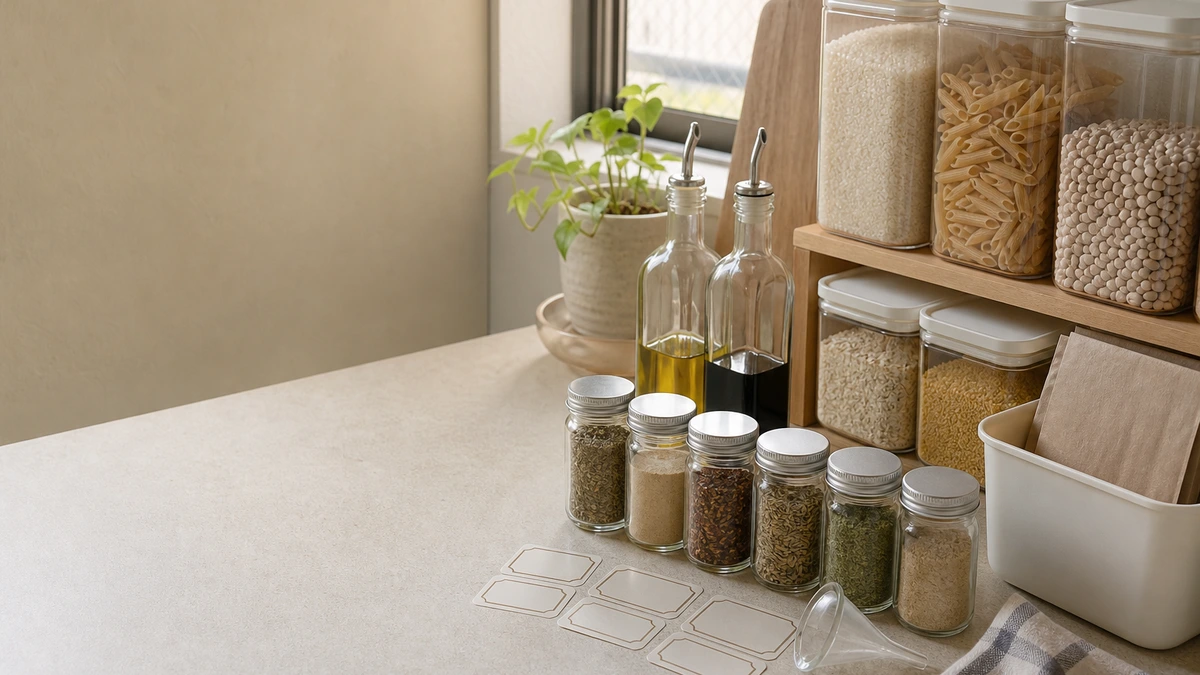
Beyond the Pinterest-perfect pantry photos, a kitchen refill station is simply a repeatable system for decanting or grouping everyday items. The point is not to make your kitchen look like a store display. The point is to make common ingredients and refills easier to use.
Your version could be as small as:
- six spice jars lined up in a drawer;
- two oil bottles beside the stove;
- a clear bin for snack packets;
- stackable containers for rice, pasta, cereal, or oats;
- a small basket for refill bags, coffee pods, tea bags, or cleaning tablets.
The goal is to reduce daily friction: bags that tip over, labels that face the wrong way, half-used packets lost at the back of a shelf, or a counter that feels busy before you even start cooking.
Before you buy
Measure this first
- Drawer height: spice jars often look short online but stop a shallow drawer from closing.
- Shelf depth: deep bins can hide items unless they have handles or slide out easily.
- Cabinet-door clearance: over-door racks and under-shelf baskets can hit hinges, inner shelves, or stored items.
- Counter footprint: oil bottles and caddies should not steal your main prep space.
- Cleaning access: avoid anything that traps crumbs, oil, water, or powder in corners you cannot reach.
Start with one messy zone
Trying to organize the entire pantry at once sounds efficient, but it usually creates more decisions than you need. Choose the one zone that annoys you most and fix that first.
Good starting zones include:
- your spice drawer or spice cabinet;
- the cooking oil and sauce area near the stove;
- a snack shelf with loose packets;
- your coffee and tea corner;
- the shelf for rice, pasta, oats, or cereal;
- under-sink storage for cleaning refills, kept separate from food.
| Area | Measure before buying | Why it matters |
|---|---|---|
| Spice drawer | Drawer height, width, and jar diameter | Jars may be too tall for the drawer to close. |
| Cabinet shelf | Shelf height and depth | Stackable containers can waste vertical space or not fit at all. |
| Countertop | Usable width beside stove or sink | Oil bottles and caddies can crowd prep space quickly. |
| Cabinet door | Door swing and inner-shelf clearance | Over-door racks may hit shelves when the door closes. |
| Under-sink area | Pipe position and cabinet height | Bins may be blocked by plumbing or hard to slide out. |
7 organizer types that make the refill look work
1. Clear spice jars
Best for: replacing messy spice bags, unifying mismatched jars, or making a drawer easier to scan while cooking.
Clear spice jars are usually the easiest way to get the refill-station look without changing the whole kitchen. They make a visible difference because spices are small, colorful, and often sold in cluttered packaging.
Check before buying:
- Fit: jar height matters more than the product photo.
- Material: glass looks cleaner; plastic is lighter and less fragile.
- Lid type: shaker, screw-top, bamboo, and metal lids all feel different in daily use.
- Set size: count your actual spices before buying a 24-piece or 36-piece set.
- Labels: check whether labels are included and whether you can read them quickly.
2. Waterproof pantry labels
Best for: jars or bins that already work, but are hard to identify at a glance.
Labels are boring in the best way. They prevent the refill system from turning into a collection of mystery powders, grains, teas, or cleaning refills.
Check before buying:
- Material: waterproof or oil-resistant labels are better near sinks, stoves, and cleaning supplies.
- Type: choose blank labels if your pantry changes often; pre-printed labels if you want consistency.
- Size: labels should fit your smallest jars, not just the biggest containers.
- Readability: choose clear fonts over decorative ones.
3. Oil dispenser bottles
Best for: cooking oil, vinegar, soy sauce, or other liquids you reach for often.
Oil bottles can make the stove area feel calmer, but only if they pour cleanly and are easy to refill. A beautiful bottle that drips every time you cook is not an upgrade.
Check before buying:
- Capacity: smaller bottles look neat but need refilling more often.
- Spout: drip control matters more than the shape of the bottle.
- Opening: a wider refill opening saves mess.
- Cleaning: make sure the spout can be removed and washed.
4. Clear pantry containers
Best for: dry goods such as rice, pasta, cereal, oats, lentils, flour, and snacks.
Clear pantry containers are useful, but they are also easy to overbuy. A large matching set can look efficient online and still be wrong for your shelves, groceries, or cleaning routine.
Start with three to five containers for the dry goods you use every week. If those work, expand later.
Check before buying:
- Height: containers must fit the actual shelf, including lid height.
- Material: food-grade plastic is light; glass is heavier but often easier to keep odor-free.
- Set mix: avoid sets filled with sizes you do not use.
- Lids: one-hand opening can matter more than a perfect airtight claim.
- Stackability: stacked containers should feel stable, not wobbly.
5. Drawer spice racks
Best for: people who want spices hidden away but still readable.
A drawer spice rack is an angled insert that points jar labels upward. It is less dramatic than a wall shelf or full pantry makeover, but it is often better for small kitchens because it uses drawer space instead of counter space.
Check before buying:
- Drawer dimensions: confirm width, depth, and height before choosing a rack.
- Capacity: count rows and jars, not just the width of the insert.
- Jar fit: check whether your jars roll, slide, or sit securely.
- Material: plastic is easy to wipe; bamboo looks warmer but may dislike spills.
6. Stackable bins
Best for: snack packets, refill bags, tea, coffee, baking packets, and small pantry overflow.
Stackable bins are not as aesthetic as matching jars, but they solve a very real problem: loose packets. They are especially useful if you buy refills or bulk packs but do not want everything spilling across a shelf.
Use them by category:
- one bin for snacks;
- one bin for tea and coffee refills;
- one bin for baking packets;
- one bin for spice refill bags;
- one clearly separated bin for cleaning refill tablets or packets.
Check before buying:
- Dimensions: width, depth, and height should match the shelf.
- Handles: handles matter if the bin sits above eye level.
- Visibility: clear bins show contents; opaque bins look calmer but hide what is inside.
- Cleaning: smooth corners are easier to wipe than decorative textures.
7. Small funnels and refill tools
Best for: anyone transferring spices, oil, powders, grains, or tiny ingredients into smaller containers.
This is the least glamorous item on the list, but it may be the one that keeps the whole system usable. If refilling jars creates a mess every time, you will stop doing it.
Check before buying:
- Neck size: the funnel should fit your smallest jar or bottle.
- Material: choose food-safe materials for ingredients.
- Cleaning: simple shapes are easier to wash.
- Set size: a small set with multiple funnel sizes can be more useful than one large funnel.
Which organizer should you choose first?
| If your problem is… | Start with this | Skip for now |
|---|---|---|
| Spice bags or mismatched jars | Clear spice jars + labels | Large pantry container sets |
| Messy oil bottles near the stove | Two easy-clean oil dispensers | Decorative bottles with narrow openings |
| Loose snack or refill packets | One or two stackable bins | Individual tiny containers for every snack |
| Rice, pasta, oats, or cereal clutter | Three to five clear containers | Huge matching sets before measuring shelves |
| Hard-to-read spices in a drawer | Drawer spice rack or angled insert | Wall racks that require drilling |
A simple starter setup for a small kitchen
If you want the refill-station look without wasting money or space, this is a sensible first round:
| Starter item | Quantity | Why it earns its space |
|---|---|---|
| Clear spice jars | 12–24 | Big visual improvement in a small footprint. |
| Waterproof labels | 1 pack | Prevents mystery jars and makes the system readable. |
| Oil dispenser bottles | 1–2 | Tidies the stove area if they pour cleanly. |
| Clear pantry containers | 3–5 | Handles your most-used dry goods first. |
| Stackable bins | 2–3 | Controls loose refill bags and snack packets. |
| Small funnels | 1 set | Makes refilling less messy, which keeps the habit alive. |
Do not buy a sprawling matching-container set until you know which sizes your kitchen actually uses. A refill station should make the space easier, not create a second organizing project.
What not to buy first
- Large 30-piece container sets: wait until you know your shelf sizes and grocery habits.
- Tiny jars for everyday staples: they look cute but need constant refilling.
- Racks that require drilling: especially if you rent or are unsure about placement.
- Containers with unclear dimensions: if the listing does not give useful measurements, skip it.
- Anything with safety, medical, or electrical claims: keep this project in low-risk storage and organization categories.
The refill-station approach works when it simplifies your kitchen. If an organizer looks great in a video but slows down cooking, cleaning, or grocery restocking, it is not the right fit.
Quick buying checklist
- Does this solve one specific mess in my kitchen?
- Will it fit the exact drawer, shelf, cabinet, or counter zone I measured?
- Are the product dimensions clear?
- Can I clean it easily?
- Will it still be useful after the trend fades?
- Am I buying a low-risk storage item, not something that makes safety or health claims?
FAQ
Are kitchen refill containers worth it?
They are worth it for items you use often: spices, oils, rice, pasta, snacks, tea, coffee, and cleaning refills that need a clear home. They are not worth it for ingredients you rarely use or containers that will sit hidden at the back of a cabinet.
What should I buy first for a refill station?
Start with clear spice jars, labels, one or two oil dispenser bottles, or a single bin for loose packets. Those are small changes that show whether the system will actually work for your routine.
Do I need matching containers?
No. Matching containers create a cleaner look, but the practical goals are visibility, fit, and easier access. A small matching set can help; a giant matching system can become clutter in a different form.
Is this only for big pantries?
No. In a small kitchen, the best refill station is usually one drawer, one shelf, or one corner. A spice drawer or coffee shelf can count if it makes the daily routine easier.
Final take
The kitchen refill station trend is useful when you treat it as a small system, not a full pantry makeover. Pick one annoying zone, measure it carefully, and choose only the organizers that make that zone easier to use.
Start with spice jars, labels, oil bottles, a few clear containers, or a couple of bins. Expand only after the first setup proves it can survive real daily cooking, cleaning, and restocking.